BEFORE YOU ARRIVE: KNOW THE CODE OF CONDUCT
The land tenure and access arrangements are complex: All kiters should familiarise themselves with the information below, and read the SSKA code of conduct before they arrive. The code in summary is;
Pay your way, know where to go, show respect.
Your behaviour will directly impact (positively or negatively) access arrangements in the future for all kiters.
If you are unsure, please ask on the Southern Lakes Snow Kiters facebook group. Better to ask than to do the wrong thing and jeapordise access for the rest of us….
GETTING THERE: PAYING FOR USING THE ACCESS ROAD
The road from Cadrona Valley to the Snow Farm Carpark is not a public road, and may be closed to vehicle traffic at any time. Road maintenance is done by the SHPG, and a road toll is payable for those who use it.
There are a few ways to pay your road contribution, and this applies to all backcountry users;
Per vehicle
When you pay per vehicle, all occupants are considered to have paid a road contributions. There are two ways to pay the road toll for a vehicle;
- Payment directly to the SHPG.
- Payment via SSKA. Paid up SSKA members (join now) can opt to pay a whole winter season* road toll for one specific vehicle.
*this season’s toll is valid for the entire winter, ie, after Snow Farm closes and until the snow runs out… )
Per person
If the vehicle you arrive in hasn’t paid a road contribution, then you must each pay as an individual.
An individual has paid their contribution by holding an all-trails Snow Farm pass ie, a full day or season pass, and only during the official Snow Farm Season*.
*Once Snow Farm closes, even if you held personally held a Snow Farm season pass, the vehicle you travel up needs to have a road toll paid via one of the methods listed in ‘per vehicle’.
A one-trail Snow Farm Backcountry Access Pass is not considered a contribution to the road. In this situation, you should have paid separately for your road toll as above.
PARKING: It depends on who you pay and what you want to do….
Parking is extremely limited at the top of the road, and is managed carefully with the goal of respecting the requirements of the various land owners and mangers. Please do your bit to keep the relationships positive up the mountain!
If you intend to use the SHPG easement
The arrangements for 2025 are still being confirmed, but you should anticipate that you won’t be able to park in the Snow Farm car park, unless you hold a valid Snow Farm Pass.
If you hold or purchase a valid Snow Farm pass
Snow Farm allows allows those with a valid pass to use their customer car park. They strongly request that everyone buys their pass online prior to arriving. See the pass options on the Snow Farm website.
As of winter 2023, a $10 ‘Backcountry Access’ day pass is available from Snow Farm. This is the fastest and easiest access from the carpark down to the public conservation area.
If there are Snow Farm Staff directing traffic, first explain that you hold (or are about to buy) a pass. Next mention that you going backcountry for the day and might be back after closing time, so they can direct you to park in a suitable spot.
If you are a SSKA member intending to start on Robrosa land
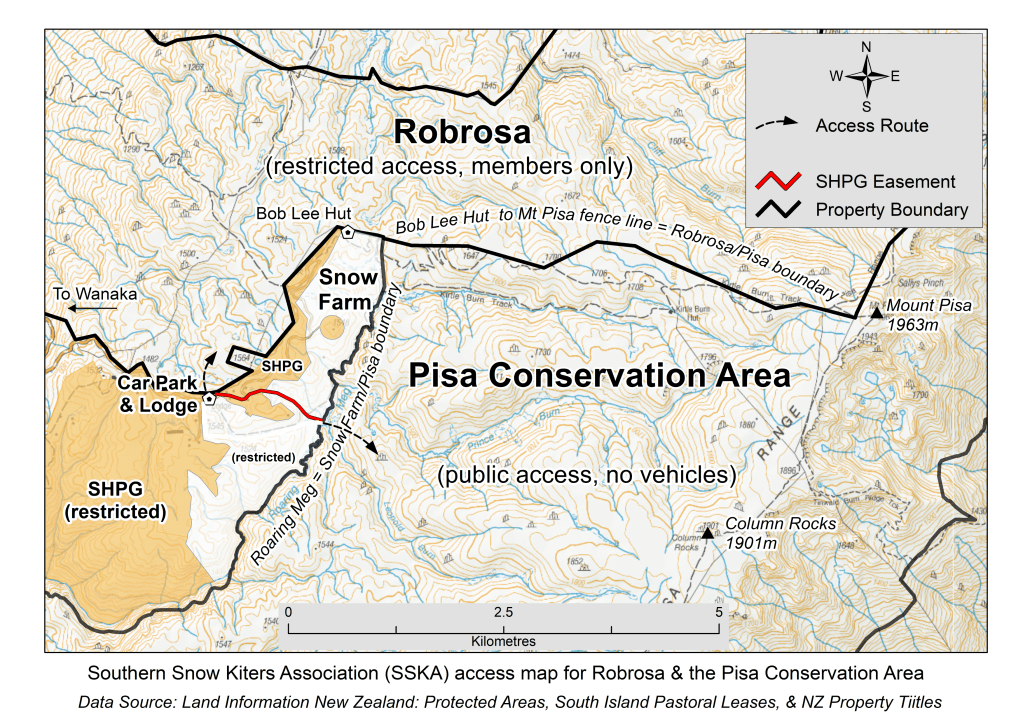
Park near the pin shown below. There’s a SSKA sign here explaining the access provisions.
This area is also used by the Snowmobile club, and the Snowmoto business operated by Robrosa Station. Park clear of turning area or any buildings, leaving clear access for trailers and customers.
From the carpark to the PISA CONSERVATION AREA
If you hold a valid Snow Farm Pass
You are entitled to use the Snow Farm Trails. (Those who hold a Backcountry Access pass may only use the River Run trail). River Run is the shortest route to the Roaring Meg Stream, where there is a crossing point. Once on the true left of the stream, you are on public land with unrestricted access.
Remember, there is absolutely no kiting allowed on Snow Farm Land! Kiter tracks are super obvious and unmistakeable, so your actions will be noticed by Snow Farm staff, which could threaten our access.
Please be courteous. The trails are intended for Nordic Skiers (many who are novices) and snow shoers. Keep your speed under control, avoid carving (which causes ruts that trip over Nordic Skiers) and also avoid crossing the ‘classic’ groomed double grooves (which some nordic skiers rely on to enjoy the trail).
If you wish to use the legal easement through the Southern Hemisphere Proving Ground (SHGPA) and Snow Farm
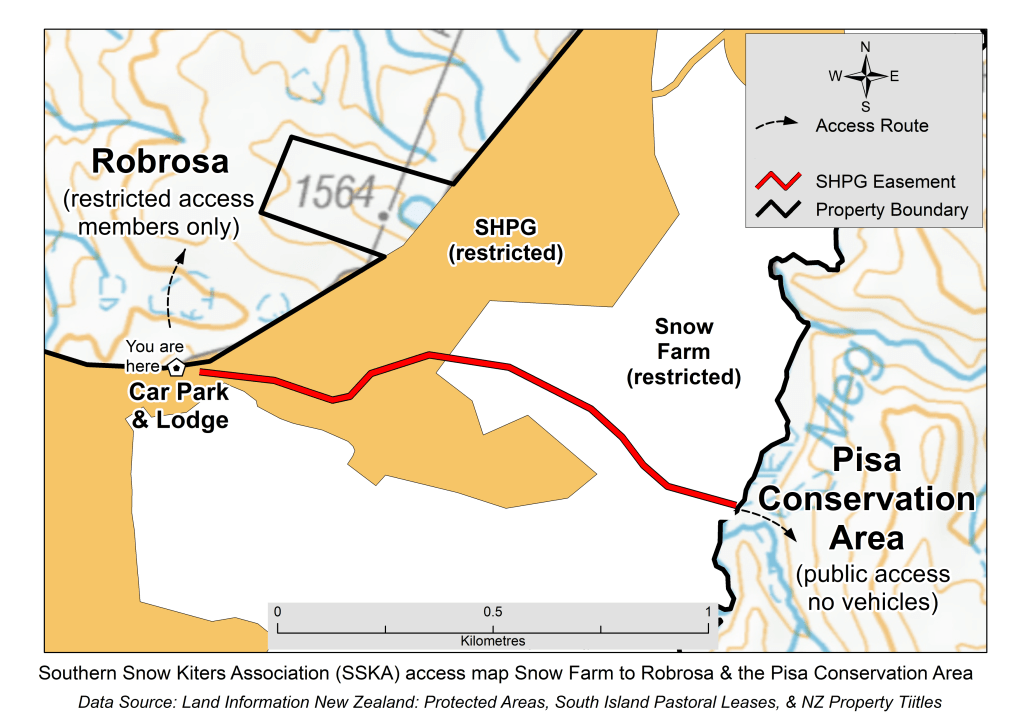
There is a legal easement, ensuring public walking access, from the carpark, through the SHPG and through part of the Snow Farm . To use the SHPG easement, refer to the SHPG Office for access protocols
Remember: other than the SHPG easement, there is STRICTLY NO access to SHPG land. Serious hazards are present and trespassers will be prosecuted. The SHPG area is fully fenced and signposted, so you can’t inadvertently wander into the wrong place.
From the Carpark to ROBROSA STATION (private farmland)
This is the land directly in front of the main SnowFarm carpark and extending to the north of the SHPG up to Mt Pisa.
From the Robrosa carpark, club members may kite between the access road, the SHPG fenceline and the snowline. Whilst some people remain in sight of the SHPG/SnowFarm base area, more interesting terrain and more space is found further to the north-east.
Access to Robrosa land is a privilege, not a right. To snow kite on Robrosa Station you must be a member of the Southern Snow Kiting Association and follow all rules relating to access and safety while on Robrosa Station land.
Kiters must give way to motorised vehicles (Snow mobiles / Snow bikes / ATVs)
There is a commercial motorised Snow biking operation, called SnowMoto run by Robrosa Station, which operates in the area. Expect most of the commercial activity to be shorter trips between the access road, and a shipping container near the SHPG fence, about 2/3 the way to Bob Lee Hut. SnowMoto also does full-day and overnight tours which head deeper into the mountains. SnowMoto clients are often first-time Snow bike riders, so it is wise to give them even more space.
Recreational motorised vehicles also have an access arrangement with Robrosa Station, so you may encounter them anywhere snowy on Robrosa Station. See the code of conduct for more guidance on how to avoid collisions/conflicts with motorised vehicles.
Turn the corner at Bob Lee Hut to reach the higher terrain
Many kiters continue past Bob Lee Hut, towards better snow conditions in the higher terrain of the Pisa Range.
When kiting past Bob Lee (and Daisy Lee Huts which are located together on the Snow Farm side of the Robrosa boundary fence) remember that you are not allowed to enter either hut unless you are booked to stay the night, and hold a valid SnowFarm Pass (full day pass or seasons pass).
Yes, that includes wanting to shelter for briefly lunch, or to use a toilet. Plan and prepare accordingly.
IN THE EVENT OF AN EMERGENCY
If you have Phone coverage, dial 111. Ask for AMBULANCE if the accident site is right next to the road. Otherwise ask for POLICE and say that you are in a remote location.
If you do not have phone coverage, activate your personal locator beacon or satelite emergency notification device.
Hazards to snow kiting exist on Robrosa Station and the Pisa Conservation Area. Common hazards include: Rocks / Cliffs / Fences / Avalanche Conditions / Inclement Weather / Streams / Ice / Whiteout Conditions. Weather can change quickly, so be prepared even if it is fine when you set out.
Robrosa Station is not liable for death/injury to yourself or any loss/damage to your personal property. SSKA members Kite on Robrosa Station land at their own risk.
BACK COUNTRY CODE
- Dispose of your waste properly – you packed it in, pack it out! Use the toilets (At base building or Kirtle Burn Hut).
- Respect wildlife and farm animals
- Respect private property, leave gates as you find them
- Be considerate of other user
RECOMMENDED SKILLS / EQUIPMENT:
- Snow kiting is a back country activity. Be prepared.
- Check the weather forecast before you go and expect very rapid changes in wind strength and visibility.
- The rolling terrain of the Pisa Range is very difficult to navigate through in poor visibility. Carry appropriate navigation equipment to find your way back to the carpark in a storm or whiteout (and know how to use it).
- Have avalanche awareness and snow skills – check the Avalanche Advisory before you go backcountry
- Carry an emergency communication device such as a personal locator beacon, or satelitte emergency notification device and know how to use it – cellphone coverage is patchy on ridge tops and non-existent in the gullies and vallies.
USEFUL REFERENCES:
- SHPG Weather Station weather.shpg.co.nz/index.html
- Avalanche Advisory: www.avalanche.net.nz
- Ski Touring Information: www.skitouringnz.co.nz
- Ski Touring Access Information skitouring.co.nz/ski-touring-access-to-the-pisa-range-rules/
- Weather Forecast (Metservice Southern Lakes):
- www.metservice.com/rural/regions/southern-lakes
- NZ Topo Maps: www.topomap.co.nz
- Snow Farm: www.snowfarmnz.com
- Southern Hemisphere Proving Grounds: www.shpg.co.nz
Copyright Southern Snowkiting Association – All rights reserved
 Southern Snow Kiters Association